
Biomass Industry
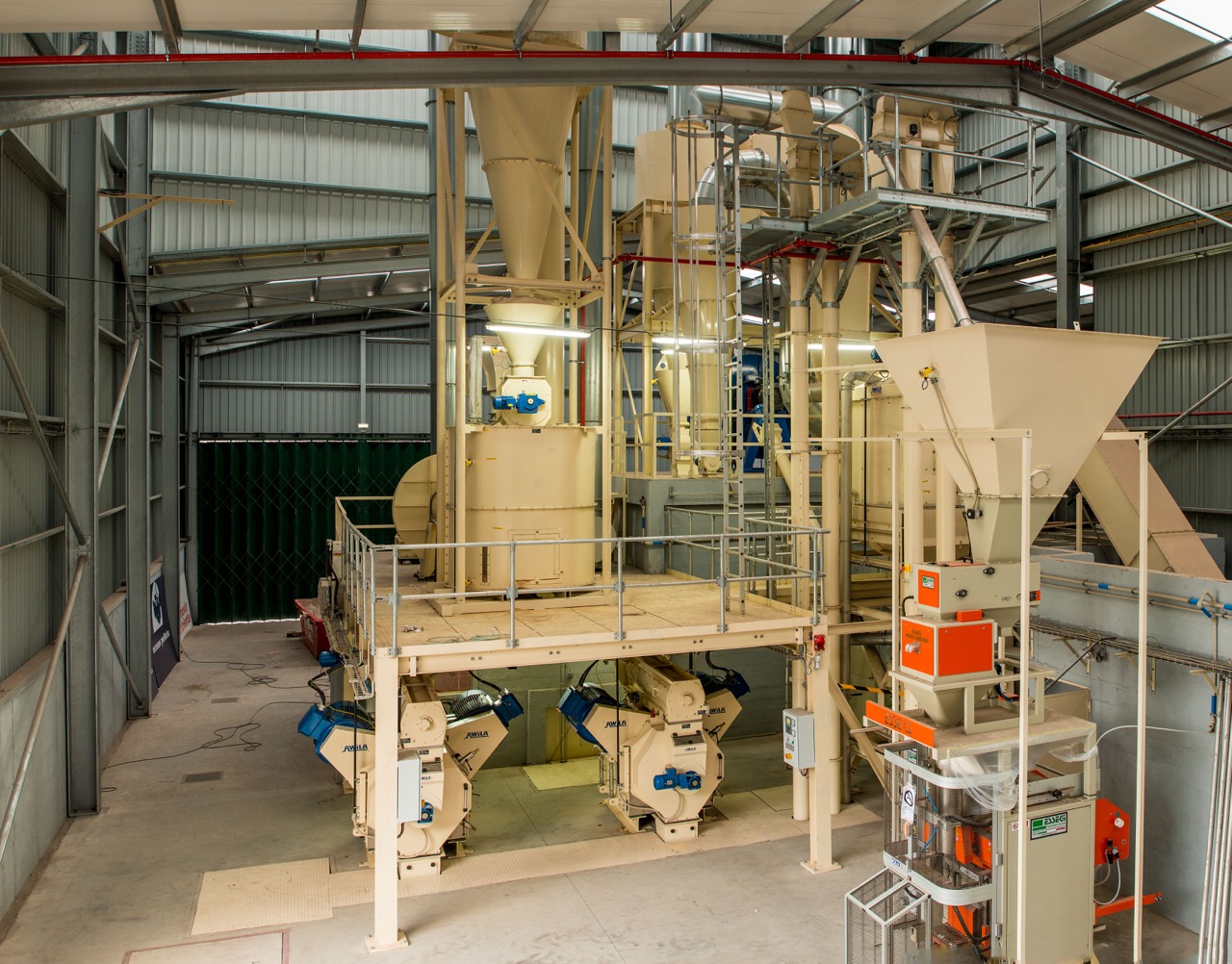

Pelleting Plants for Wood and Straw
Wood, straw and residual materials become pellets. That only works if the preparation beforehand is right: size reduction and grinding determine the particle size the press can actually work with.

Presses from
1 t
per hour
Pellets with
6–8 mm
diameter
Lines up to
10
tonnes
per hour
Biomass Industry
Wood and Straw Pelleting Plants
From size reduction through grinding and conditioning to the press – designed for variable input material.

Wood residues need preparation designed for variability.
Wood chips, sawdust and shavings often differ in moisture, fiber length and resin content from delivery to delivery. Press them unchanged and you get pellets with inconsistent density and binding.
That’s why we design drying, grinding and conditioning for the range of your material – with tools that withstand the resin and fiber content instead of only working at the ideal value.

Straw behaves completely differently from wood.
Straw is light, long-fibered and low in natural binding agents – without sufficient pressure and temperature, the pellet falls apart again almost as soon as it leaves the press. The high mineral and silicate content also wears down dies and press rollers significantly faster than with wood.
We design size reduction, pre-compression and press tooling specifically for straw – with more wear-resistant materials wherever straw genuinely needs them.
Our Working Process With You
Five steps from the first inquiry to ongoing operation – with the same contacts throughout.
-
 Consulting & Planning We clarify what the plant needs to achieve: product, throughput, space and budget. This becomes a concept before we even talk about machines.
 -
 Engineering & Production Our design team develops the plant in detail, and our own production builds the matching components – both in-house in Lastrup.
 -
 Project Management One point of contact coordinates schedules, deliveries and trades, and speaks up before a deadline slips – not after.
 -
 Installation & Commissioning Our own fitters install the plant and start it up until throughput and accuracy reach the agreed values.
 -
 Ongoing Support After handover, the same contact person remains responsible – for spare parts, maintenance and future expansions.


Wood and Straw Pelleting Plants
Our Plants for the Biomass Industry

Wood Pelleting Plants
Wood chips and sawmill by-products are size-reduced, ground and pressed into pellets of consistent quality.

Straw Pelleting Plants
Straw is fibrous and light – requiring different tools, discharge systems and pressing conditions than wood.

Residual Material Recovery
By-products from the food and agricultural industries become a usable raw material that’s storable and transportable.

Fuel Preparation
Defined particle size and moisture are the prerequisite for even combustion.

Extraction & Dust Technology
No side issue with biomass: dry dust from organic material is both a safety and a quality question.

Interested? Get in touch!
Contact us nowDo you want to process wood, straw or residual materials into pellets? Describe your input material and desired end product – we'll get back to you.

Plant reaching its limits?
It’s usually wear.
With biomass, wear is the dominant cost factor. When throughput or particle size decline, it’s almost always due to tooling, screens or linings – rarely the machine itself.
We inspect the plant, replace wear parts made in our own production, and tell you where a more wear-resistant design pays off.
Individual Machines for Biomass Processing
Size reduction, grinding, pelleting – the path from delivered material to finished pellet.


Knowledge
Frequently Asked Questions About the Biomass Industry
-
Wood, straw, other crop residues and a whole range of by-products from the agricultural and food industries. What matters isn’t the material’s name but how it behaves – we clarify that in advance.
-
Size reduction brings the material down to a manageable size, grinding then produces the defined final particle size. With biomass, both stages are almost always needed in sequence.
-
Significantly higher than with grain, especially when sand or mineral residues are present in the material. We use correspondingly wear-resistant tooling and keep replacements in stock.
-
Through enclosed construction and adequately sized extraction with a cyclone. With biomass, this isn’t a matter of comfort – dry dust from organic material can be explosive.
-
Yes. You can order a single mill and integrate it into your existing processing setup – we adapt the connections and controls.