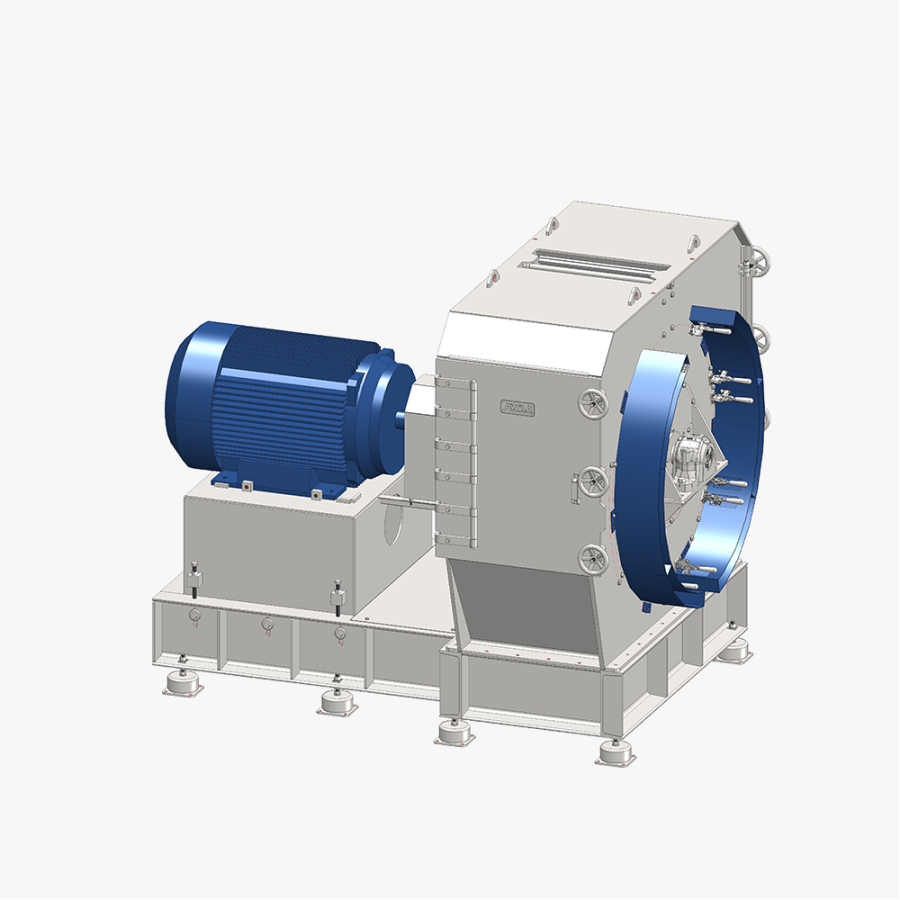
Hammer Mill
Size Reduction
Grinds grain to the desired fineness – adjustable via screen selection from coarse meal to fine flour.


Hammer mills and roller mills for grain, animal feed and bulk materials – designed for your recipe and the throughput you actually run.

Particle size determines how well a mixture can later be homogenized, how stable the pellets become, and how well the feed is utilized. Grind too fine and energy consumption rises without added benefit – grind too coarse and product quality suffers.
That’s why we don’t design the machine to a catalog value, but to your product: we clarify which raw materials run through the mill, what screening you need, and what throughput the downstream plant can handle.

Grinding tools and screens are wear parts – so we’ve designed our mills to allow replacement without special tools. Matching hammers and screens come from our own production, even for machines that have been running for decades.
About Size Reduction

Are you planning a new plant for size reduction or want to expand an existing one? Briefly describe your product and desired throughput – we'll get back to you.
Size Reduction
That depends on the screen used, the raw material, and the peripheral speed. Instead of a catalog figure, we clarify with you what end product should result, and select the screening accordingly.
The hammer mill is the all-rounder for fine grinding of different raw materials. The roller mill crushes more gently, more evenly and with significantly less energy – worthwhile wherever a coarse, defined particle size is required.
That depends on the raw material and operating hours – abrasive products wear significantly faster. At the maintenance appointment, we check the condition and tell you when the next replacement is due.
A mill is never quiet, but the sound level can be effectively limited: through placement, a sound-insulated enclosure, and silencers in the extraction system. We clarify what makes sense in your case before planning.
Yes. We look at what’s positioned before and after the mill – dosing, extraction, conveying – and adapt the connections and controls. Replacing an old mill during ongoing operation can also be planned.